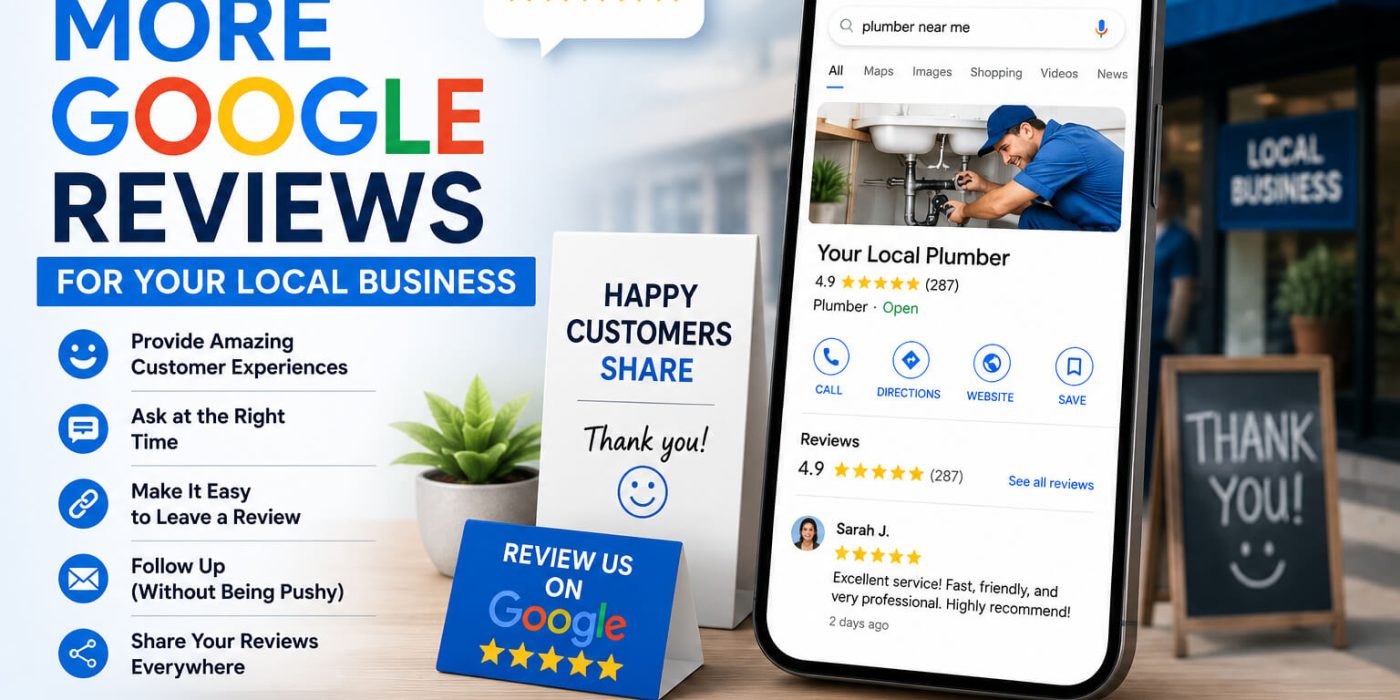
Google reviews are one of the most visible trust signals for any local business. They appear directly in search results, in Google Maps, and on your Google Business Profile — before a potential client has visited your website, read your about page, or spoken to anyone at your company. For many small businesses, the review count and star rating is the first impression they make.
Despite this, most small businesses have far fewer reviews than they should. Not because their clients are unhappy — because asking for reviews feels awkward, the process isn’t easy enough for clients to follow through, and there’s no consistent system for making it happen.
Here’s how to fix that without being pushy, without gaming the system, and without violating Google’s guidelines.
Why Google Reviews Matter More Than You Think
Google reviews influence local search rankings directly. A business with 50 genuine reviews and a 4.7 average will consistently outrank a competitor with 5 reviews and a 5.0 average for local searches. Volume and recency both matter — a steady stream of recent reviews signals an active, legitimate business more convincingly than a cluster of old ones.
They also function as social proof at the exact moment a potential client is making a decision. Someone searching for a WordPress developer or a web maintenance service and seeing five results will naturally gravitate toward the one with the most reviews and the highest rating. The content of those reviews — specific outcomes, named problems solved, professional qualities mentioned — provides the kind of reassurance that no marketing copy can replicate because it comes from people with nothing to gain from saying it.
A business with no reviews isn’t neutral — it reads as unestablished or untrusted, particularly to clients who are comparing multiple options. In competitive local markets, the difference between 8 reviews and 40 reviews is often the difference between getting the inquiry and not.
The Simplest System That Actually Works
The businesses that accumulate reviews consistently aren’t the ones with the most sophisticated review management tools. They’re the ones that ask every satisfied client, make the process as frictionless as possible, and do it consistently rather than occasionally.
The highest-conversion moment to ask for a review is immediately after a positive interaction — when a project is completed successfully, when a problem is resolved and the client expresses satisfaction, when someone thanks you unprompted. That’s the moment the positive experience is freshest and the motivation to share it is highest. Waiting a week reduces conversion rates significantly.
The ask itself should be direct and specific. “Would you mind leaving us a Google review? It makes a real difference for a small business like ours” is more effective than a vague “if you get a chance.” People respond to direct, honest requests more readily than hints.
Then make the process as easy as possible. The fewer steps between the ask and the completed review, the higher the follow-through rate. The best tool for this is your Google Business Profile review link — a direct URL that opens the review dialog immediately, with no searching required.
How to Get Your Google Review Link
Log into your Google Business Profile at business.google.com. In the dashboard, look for “Ask for reviews” or “Share review form.” Google will provide a short link you can copy. This link takes anyone directly to the review dialog for your business — no searching, no navigating, just a direct path to leaving a review.
Save this link somewhere accessible. You’ll use it in emails, text messages, and anywhere else you follow up with clients after a successful engagement.
How to Ask — By Channel
In person or by phone: After a successful project or resolved issue, when the client expresses satisfaction verbally, ask directly: “I’m really glad that worked out well for you. If you ever have a moment, a Google review would mean a lot to us — I can send you the link right now if that’s helpful.” Then follow up with a text or email immediately while the conversation is fresh.
By email: A short, personal email works better than a formal review request. Two to three sentences, addressed to the client by name, referencing the specific project or issue you helped with, with the review link prominently placed. Not a template that reads like a template — a message that reads like it came from a real person who worked with them.
By text: For clients you have an informal relationship with, a brief text message with the review link has high open and follow-through rates. Keep it conversational: “Hey [name], really glad we got that sorted for you. If you have a second, a Google review would be a huge help — [link].”
After project delivery: Include the review link in your project completion message or invoice email. A short line at the end — “If you’re happy with how everything turned out, a Google review is the best way to support what we do” — is appropriate and non-pressuring.
What Google’s Guidelines Actually Say
Google prohibits incentivizing reviews — offering discounts, gifts, or any benefit in exchange for leaving a review. It also prohibits review gating, which means only asking satisfied clients for reviews while filtering out unhappy ones before they reach Google. Both practices violate Google’s terms and can result in reviews being removed or your Business Profile being penalized.
What Google does permit — and actively encourages — is simply asking clients to share their honest experience. The ask itself is fine. The incentive is not. Keep the request straightforward and honest and you’re well within the guidelines.
Responding to Reviews — Every Single One
Responding to Google reviews is as important as collecting them. Google factors review responses into local search rankings. Potential clients read responses as a signal of how you treat your customers — both the ones who are happy and the ones who aren’t.
For positive reviews, respond with genuine specificity rather than a template. Reference something from the review content, thank the client by name if they used it, and keep it brief. A response that reads like it was written by a human who remembered the interaction builds more trust than “Thank you for your feedback! We appreciate your business.”
For negative reviews, respond promptly, professionally, and without defensiveness. Acknowledge the experience, take responsibility for anything that went wrong, and offer to resolve the issue offline. Potential clients reading a negative review aren’t only evaluating the complaint — they’re evaluating how you handled it. A professional, empathetic response to a negative review often does more for your reputation than the negative review does against it.
Building a Consistent Habit
The businesses with the most reviews aren’t running periodic review campaigns — they’re asking consistently as part of their standard client workflow. Every completed project, every resolved issue, every satisfied client interaction is an opportunity to ask.
If you close five client engagements per month and ask all five for a review, even a 40% conversion rate produces two new reviews per month. Twenty-four new reviews per year. Over two years, that’s a profile that looks meaningfully different in local search results than one with five reviews from the year the business launched.
The reviews are there to be earned. The clients who would leave them are the ones you’re already working with. The only missing piece is a consistent, comfortable habit of asking.